In 1815 the prize for the main race at Southwell was a saddle and bridle. The winner of the donkey race took home a tea kettle. Racing then was held on the Burgage, the green on the edge of the little cathedral town, and the Whitsuntide meeting was the one everybody went to. Two centuries on, the racing has moved a couple of miles east to Rolleston, the prizes are rather larger and the horses now race under some of the most advanced floodlights in the sport. For anyone in Mansfield, it is the nearest racecourse to home, and this October it is one of the busiest in the country.
The October 2026 fixtures
Southwell's official listings for the rest of the month are:
- Saturday 3 October: Oktoberfest racenight (evening)
- Tuesday 6 October: floodlit flat racing
- Thursday 8 October: floodlit flat racing
- Saturday 10 October: Oktoberfest racenight (evening)
- Tuesday 13 October: afternoon jump racing
- Thursday 15 October: floodlit flat racing
- Saturday 17 October: floodlit flat racing
- Monday 19 October: floodlit flat racing
- Thursday 22 October: floodlit flat racing
- Saturday 24 October: Gents Evening
- Monday 26 October: floodlit flat racing
- Thursday 29 October: floodlit flat racing with a drone show
- Saturday 31 October: Halloween racenight
The course also raced on the afternoon of Thursday 1 October. With so many dates, it is worth checking which are themed nights and which are straightforward racing before you book.
How Southwell got here
After its days on the Burgage, Southwell racing found its permanent home at Rolleston in 1898. The site sits on low ground between the River Trent and the River Greet, beside a railway station that made it easy for racegoers from Nottingham and the wider Midlands to arrive in numbers, and for the horses themselves to be unloaded off the trains.
For most of the twentieth century Southwell was a modest country jumping track. Its transformation came in 1989, when it became one of Britain's first all-weather courses, laying a surface of Fibresand, a mixture of sand and fibres. The first all-weather race there was run at 1.10pm on 1 November 1989: a novice hurdle, won by Zulu for the trainer Martin Pipe. All-weather jumping did not last, but the all-weather flat racing that followed turned Southwell into a year-round venue.
The location by the rivers has also brought trouble. Floods in 2009 and again in 2012, when the Greet burst its banks, rose about a metre across the site and destroyed much of the racing surface. After the December 2012 flood the course closed and its fixtures moved to Wolverhampton and Lingfield until it reopened on 5 February 2013. A four-kilometre clay bund, finished in December 2017, now rings the course to direct water into flood cells and release it slowly.
Two more changes followed. Floodlights by Musco, the firm that lights some of Britain's biggest stadiums, were switched on for evening racing in 2019. Then in December 2021 the Fibresand, with its famously deep and testing kickback, was replaced by Tapeta, a blend of sand, wax and fibre.
Southwell also has a strong local connection in the weighing room. Hayley Turner, one of the most successful female jockeys in British racing, grew up locally and began her career at a training yard next to the course.
For the seasoned racegoer
The all-weather track is a left-handed oval of a mile and a quarter, with fairly tight bends at each end and a run of about three furlongs from the home turn. A two-furlong spur gives Southwell a straight five furlongs, the second-longest straight on any British all-weather course after Newcastle's straight mile.
The Tapeta era has changed how the track is read. Form from the Fibresand years, when Southwell was known as a specialist's course where some horses simply loved the surface and others hated it, should be treated with care. Races still tend to be run at a good gallop and stamina matters, but the switch has made Southwell a more conventional all-weather test.
Southwell's major all-weather races, the Listed Churchill Stakes and Golden Rose Stakes, are November fixtures, so the October cards are mostly handicaps and maidens. The Tuesday 13 October afternoon is on the separate turf jumps course.
For a first visit
A floodlit evening is a good way to start racing. The atmosphere on themed nights can be lively, while the ordinary weekday cards are quieter and more about the horses. Dress is relaxed; on an October evening a warm coat and gloves are worth more than any fashion choice.
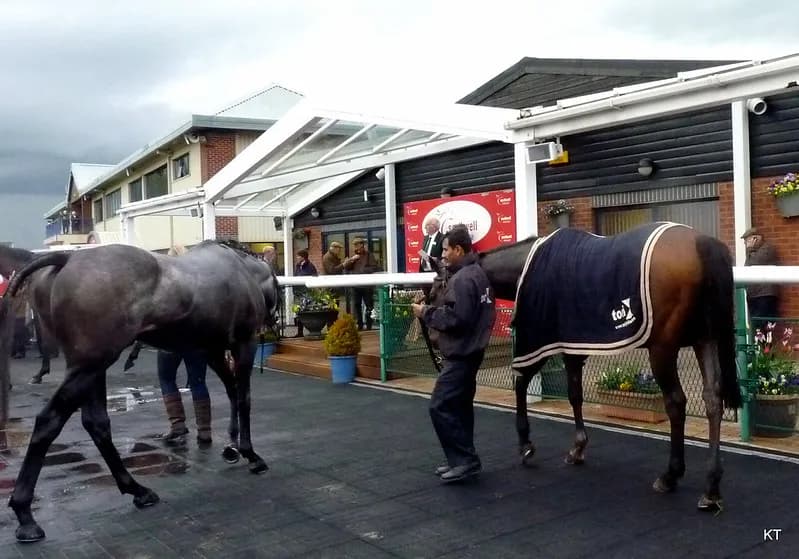
The paddock, or parade ring, is where to begin. The horses walk round before each race, and you can stand a few feet away. A calm horse with a relaxed walk and a bright coat is usually a better sign than one that is sweating, jig-jogging or pulling its lad. Under the lights, the racing itself is easy to follow on the big screen and across the open, flat track.
For a bet, the Tote pools the stakes and shares them out among the winners, so you find out the return after the race. Bookmakers give you a fixed price when you place the bet. An each-way bet is two bets in one, half on the horse to win and half on it to place, so it costs double your stake. Settle on a budget before the first race and treat it as the price of the evening.
Making a day of it in Southwell
Arrive in daylight and Southwell itself rewards a few hours. Southwell Minster, the cathedral for Nottinghamshire, has a Norman nave and, in its Chapter House of about 1288, the carvings known as the Leaves of Southwell, among the finest naturalistic stone carving of the thirteenth century anywhere in the country. The Minster became a cathedral when the diocese was created in 1884. Beside it are the ruins of the Archbishop of York's palace, where the restored State Chamber was once Cardinal Wolsey's dining room.
A short walk away, The Workhouse, now cared for by the National Trust, is one of the most affecting historic buildings in the Midlands. Built in 1824 and shaped by the Reverend John Becher, its strict system of separation became a model for workhouses across the country after the Poor Law of 1834.
The town's streets hold other stories too. Charles I spent his last night as a free man in Southwell in May 1646 before surrendering to the Scottish army at nearby Kelham. Lord Byron spent school holidays at Burgage Manor on the green where the races were once run. And the Bramley apple began here, grown from a pip by Mary Ann Brailsford in 1809.
For a walk with a Mansfield connection, the Southwell Trail follows the old railway trackbed west out of the town towards Mansfield, a level path for walkers, cyclists and families.
Getting there from Mansfield
The racecourse is at Rolleston, about two miles east of Southwell. By car, the A617 runs from Mansfield through Rainworth towards Kirklington, from where Southwell is a short drive. By rail, Rolleston station stands beside the course on the line between Nottingham and Newark, but services are limited, so plan around the timetable, especially for an evening meeting.
Before you go
Check the Southwell Racecourse website for first-race times, tickets, the themed events and any changes. All-weather racing is rarely lost to rain, but the jumps card and any meeting can still be affected by weather, so look again on the day.