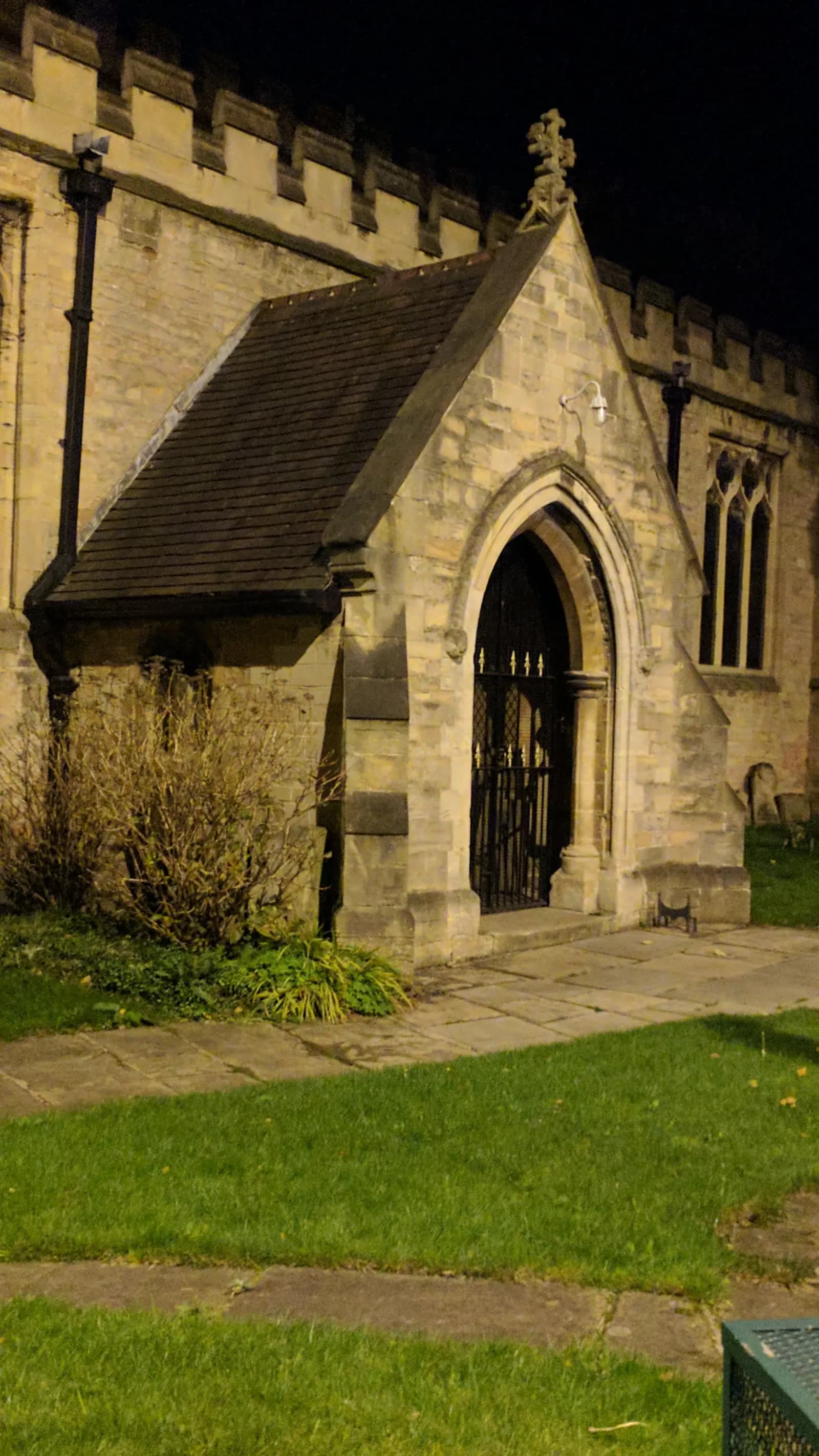
St Peter and St Paul's Church in Mansfield stands as a Grade I listed building with a claim few English churches can match: it was here, in 1647, that George Fox received the revelation that led to the founding of the Quaker movement.
The church's origins stretch back to the Norman period, with portions of the current structure dating to the 12th century. A stone base from the original Norman tower still survives on the east side, and Norman zigzag moulding remains visible in the chancel wall.
From the Domesday Book to the Reformation
The church first appears in the Domesday Book of 1086, which records two churches and two priests in Mansfield. In 1092, William II transferred the church to Robert Bloet, Bishop of Lincoln. By the 12th century, a new stone nave and chancel had been constructed, and the 13th century saw major expansion with the addition of both arcades and a new south aisle.
Disaster struck in 1304 when fire destroyed the church and neighbouring houses. Restoration was completed by 1420, though the building was taxed at only four shillings and fourpence in 1428, a fraction of its 1291 valuation of £26 13s 4d. A steeple was added in 1583, though architectural historian Nikolaus Pevsner disputed this date, arguing for 1666. The church registers commenced in 1559, amongst the oldest in the area.
George Fox and the Birth of Quakerism
In 1647, George Fox arrived in Mansfield and took work as a shoemaker. He rented a cottage on what is now Chesterfield Road South, at the site where St Philip Neri Catholic Church now stands. It was during this period that Fox experienced a revelation that would reshape English religious history.
Walking past St Peter and St Paul's, Fox later wrote in his journal: "and as I was walking by the steeplehouse side, in the town of Mansfield the Lord said unto me, that which people do trample upon must be thy food." Fox used the term "steeplehouse" to describe established churches, and this moment marked a turning point in his rejection of formal religious structures. The movement that became the Religious Society of Friends, or Quakers, had its spiritual origins on the streets of Mansfield.
Fox met Elizabeth Hooton at her home in nearby Skegby; she is considered the first person to accept Quakerism. By 1649, Fox's activities had drawn the attention of authorities, and he was imprisoned in Nottingham for interrupting a service at the church in Mansfield Woodhouse.
Restoration and Recognition
Between 1870 and 1871, architect William Smith oversaw a major restoration that removed galleries, exposed the Norman tower arch, rebuilt the roofs, and installed stained glass. The church was designated Grade I listed on 19 December 1955. The boundary wall and gates to the churchyard received Grade II listing in 1993.
The church bells date from 1603 and were recast in 1948. The organ, a three-manual instrument acquired from Clare College Cambridge in 1970, was installed in 1971 and reconsecrated in 2000.
Exploring Mansfield's Quaker Heritage
Mansfield has embraced its role in Quaker history through the Mansfield Quaker Heritage Trail, managed by Nottinghamshire County Council in partnership with University of Nottingham theology students. The trail begins at the Quaker Way entrance of Mansfield Bus Station, where a memorial plaque marks the site of the Old Meeting House built in 1702, the oldest nonconformist place of worship in Nottinghamshire.
The trail connects key sites including Quaker Lane, almshouses founded in 1691 by Elizabeth Heath, and the location of Fox's former cottage. Nottinghamshire County Council offers an audio tour with ten tracks available for download.
St Peter and St Paul's Church remains an active place of worship within the Diocese of Southwell and Nottingham. Visitors can view the architectural layers that span nine centuries, from Norman stonework to Victorian restoration, whilst standing at the site where one of England's most influential religious movements took shape.